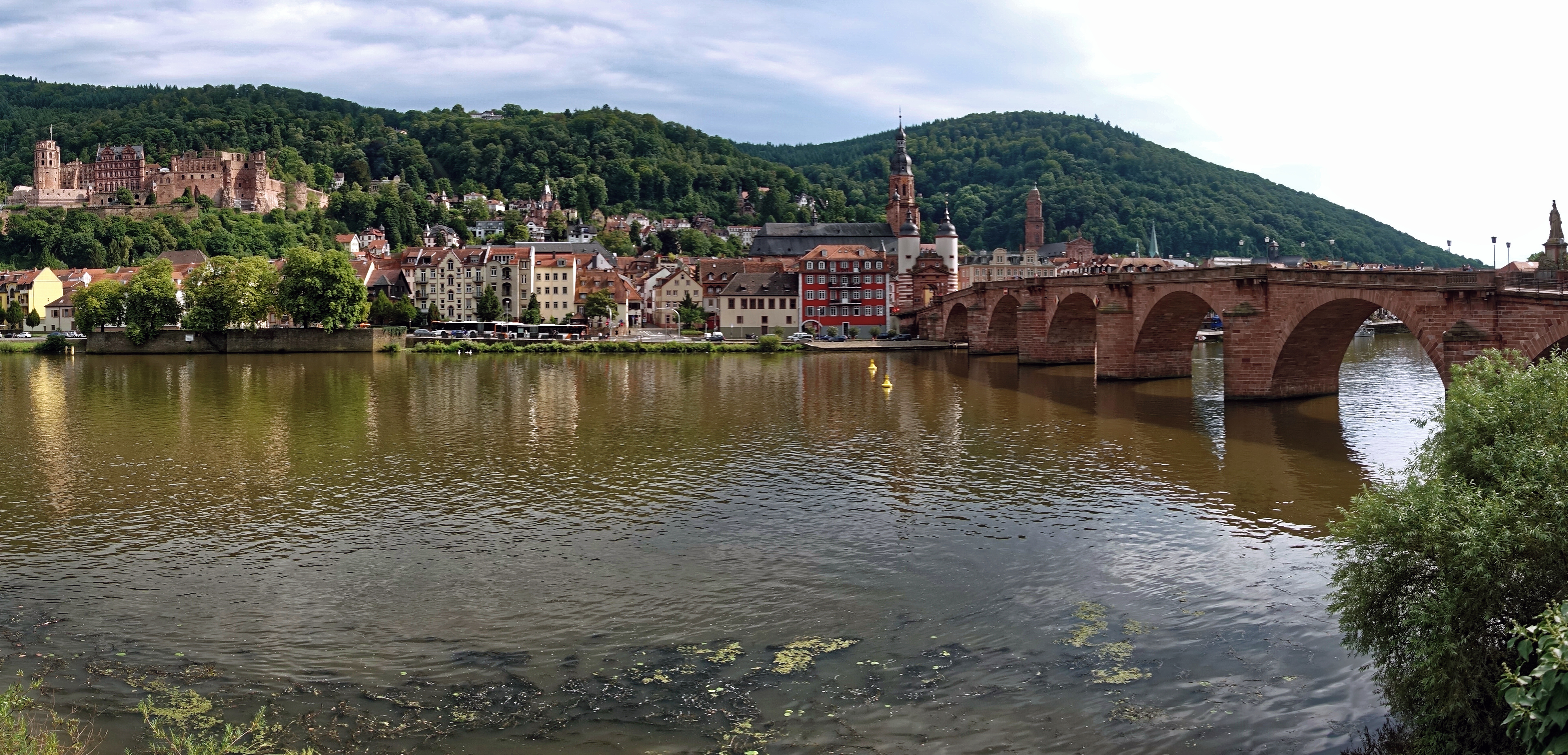

Some cities you admire. Heidelberg is one you fall for — I did, and it stays on my list of favourite German cities no matter how many times I go back.
It sits in the south-west, where the Neckar river slips out of the hills toward the Rhine, and it has the kind of silhouette travel posters are made of: a great ruined castle in warm red sandstone on the wooded slope, a stone bridge below it, and a long old town of church spires and gabled roofs in between. Mark Twain came here in the 1870s, wrote about the place at length in A Tramp Abroad, and concluded he had never seen a place that pleased him more. He was not wrong.
The castle above the river
Heidelberg Castle (Heidelberger Schloss) was the seat of the Electors Palatine — rulers of this corner of the Holy Roman Empire — and it grew over centuries into a palace-fortress of Gothic and Renaissance wings. Wars in the 1600s and two lightning fires in the 1700s left it a ruin, and the strange truth is that the ruin is more loved than most intact castles. The red sandstone glows at the end of the day, half the walls open to the sky, and the whole town below seems arranged for its benefit.
Walk up — or ride the funicular — and go through the gate into the courtyard for the best first impression: mismatched facades from different centuries facing each other like a stone family portrait.
Down in the cellar: a barrel the size of a house
Every castle has a wine cellar. Heidelberg’s has the Heidelberg Tun, built in 1751 and quite possibly the most famous barrel in the world: it holds around 220,000 litres — roughly 290,000 bottles of wine — and it was filled, in its working days, with wine paid as tax by the region’s growers. There is a dance floor on top of it. That detail tells you everything about the Palatinate’s attitude to wine, and it is an attitude I fully support.

The Old Bridge and the old town
Below the castle, the Alte Brücke (Old Bridge) crosses the Neckar in nine stone arches. The bridge standing today was built in 1788 — earlier bridges here were washed away or destroyed so often that the town finally built in stone — and its medieval gate towers, with their twin round helmets, still guard the old-town end. Stand in the middle at dusk: castle behind you lit up, river below, and the hills going blue on both sides.

The bridge lands you in the Altstadt, Heidelberg’s old town, strung along the Hauptstraße — at around 1.8 kilometres, one of Europe’s longest pedestrian streets. It runs the full length of the old town: cafés, bakeries, bookshops and wine taverns on streets that were already old when the bridge was new. Halfway along, the Marktplatz opens out around the Heiliggeistkirche, the great Gothic Church of the Holy Spirit that has anchored the square since the Middle Ages — market stalls in front, church behind, castle above. That layering, in one glance, is Heidelberg.
The view from the Philosophenweg
For the postcard, cross the river and climb to the Philosophenweg — the Philosophers’ Walk — a sunny path along the north bank where Heidelberg’s professors and philosophers once strolled and thought deep thoughts. The thinking is optional now. The view is not: old town, bridge and castle laid out across the water in one sweep. Go late in the day, when the sandstone does its glowing trick.

A university town since 1386
Heidelberg is not a museum, and the reason is its students. The University of Heidelberg, founded in 1386, is Germany’s oldest, and its students still fill the old town’s cafés and kneipen (pubs). Their history has teeth, though: for roughly two hundred years, unruly students were locked up in the Student Prison (Studentenkarzer) for offences like brawling and midnight noise-making — and they covered its walls with graffiti, portraits and boasts about their sentences, which you can still read today. It may be the only jail in the world whose inmates left it as an artwork.
How Heidelberg fits into a trip
- Getting there: about an hour by train or car from Frankfurt and its airport — one of the easiest “storybook Germany” additions to a bigger itinerary.
- On the river map: the Neckar flows into the Rhine just downstream at Mannheim, so Heidelberg pairs naturally with a Rhine journey — the castle gorge, the wine towns, and (in season) the Rhine in Flames nights I wrote about earlier in this series.
- How long: you can see the highlights in a day, but give it two — one for the castle and old town, one slow morning for the Philosophenweg and the cafés. Heidelberg rewards lingering; it has had six centuries of practice.
Planning Germany?
I plan custom Europe trips with no planning fees. Tell me your dates and how you like to travel, and I’ll place Heidelberg where it belongs in your trip — it deserves more than a photo stop.
DM me ‘HEIDELBERG’ on Instagram @travelwithheike, use the contact page here, or email travelwithheike@yahoo.com.
— Heike, Travel with Heike
Europe specialist 🇩🇪 • Hidden gems, storybook towns & river cruises • Custom trips, no planning fees
This post is part of my Germany series: Trier, my hometown · Bernkastel-Kues, my favourite wine town · Rhine in Flames. More favourites to come: Idar-Oberstein, the gemstone town, and Bremen in the north.
Leave a Reply